Why the smallest ask you can make is often the most powerful one
It’s 2018, every workshop I run hits the same moment. The room is fired up, the flipchart is full of good ideas, and someone asks the question that quietly kills all that energy: “So what do we actually do now?”
The instinct is to hand people everything. The whole action plan, every insight from the day, every improvement worth making. It feels generous. It’s actually the opposite of helpful.
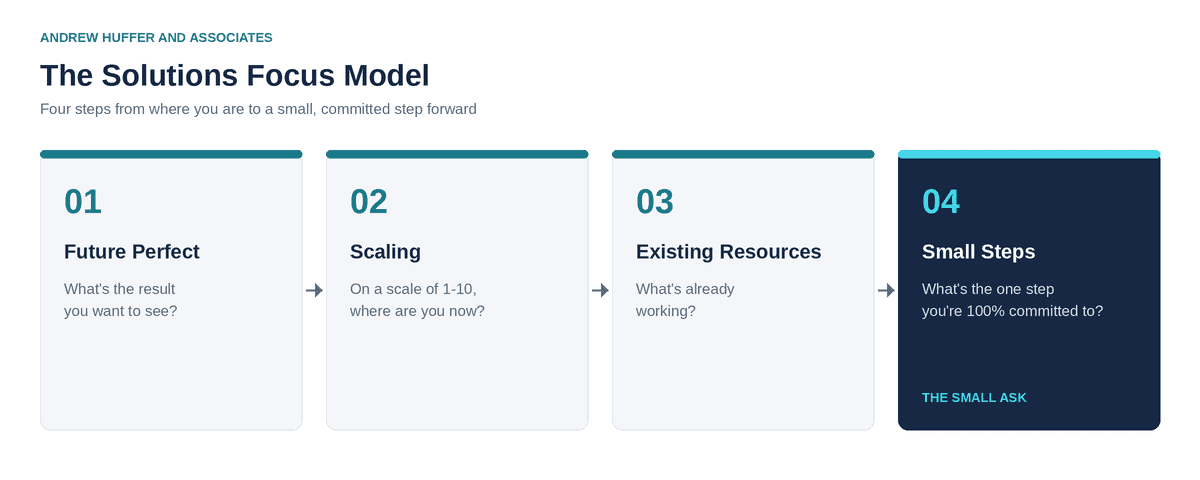
This is where Solutions Focus coaching earns its keep. I’ve built the model, developed by Paul Z Jackson and Janine Waldman, into my facilitation work since 2019, and it comes down to four moves:
- Get clear on the future you want
- Work out where you already sit on the way to it
- Name what’s already working
- And then ask the only question that matters…
“What’s one small step you’re 100 per cent committed to taking?” One step. Not the whole plan – without the first step, it’s dust.
A small ask case study
Tracey White, Senior Advisor at Victoria State Emergency Service, put that idea to the test at the 2025 Royal Melbourne Show, in a presentation I coached her through for the AFAC26 conference. Instead of a full emergency preparedness checklist, VICSES asked visitors to choose one thing and commit to it.
Over eleven days, 591 people made a commitment, 77 per cent agreed to follow-up, and 27.2 per cent later reported they’d actually done it. That’s not just a busy stand. That’s measurable behaviour change, and it earned VICSES a Gold Ribbon for Community Connection for the ‘Do 1 Thing‘ campaign.
Applying the solutions focus
The pattern holds whether you’re running a strategy workshop, a stakeholder session or a community campaign. A big ask gives people something to admire and nothing to do. A small, self-chosen ask gives them somewhere to start, and starting is what builds the confidence to keep going.
Next time you’re designing a session, resist the urge to end on a five-point action plan. End on one question instead: what’s the one thing you’re prepared to commit to before we leave this room? Then watch what happens when people actually do it.
If you’d like help building this kind of momentum into your next workshop or campaign, get in touch and let’s talk.
FAQs
What is Solutions Focus coaching?
Solutions Focus is a coaching model developed by Paul Z Jackson and Janine Waldman. Rather than dwelling on problems, it moves people through four steps: getting clear on the future they want (Future Perfect), placing themselves on a scale toward it (Scaling), naming what’s already working in their favour (Existing Resources), and committing to one small step forward (Small Steps). I’ve built it into my facilitation practice for years because it gets groups to action fast, without getting bogged down in everything that’s wrong.
When can a “small ask” work better than a full action plan?
A long action plan asks people to hold ten decisions in their head at once, which is exactly the kind of overwhelm that stops anyone starting. A single, achievable, self-chosen step removes that friction. It’s also more personal: the action means something because the person picked it, not because it was handed to them on a page.
How did VICSES measure whether people actually followed through? Through a consent-based follow-up process. Visitors to the Do 1 Thing activation chose an action and opted in to a follow-up message. Of the 591 people who made a commitment, 77 per cent agreed to that follow-up, and 27.2 per cent later confirmed they’d completed their chosen action. That follow-up loop is what turned a busy stand into a measurable behaviour-change result. See the Conference Presentation Abstract prepared by Tracey.
How can I use this small-step technique in my own workshops or campaigns? Close the session by asking one question instead of presenting a plan: what’s the one thing you’re prepared to commit to before you leave this room? Let each person choose their own step, then build in a genuine follow-up, a call, an email, a message, so the commitment doesn’t evaporate the moment they walk out the door.

Reader Interactions