Two ideas changed how I think about facilitating for people under pressure
At the IAF Oceania conference in Geelong, I joined Sue Langley’s session, The Future is Human: Facilitation at the Human Edge.
Sue translates neuroscience, emotional intelligence and positive psychology into tools people can use the same day.
She covered a lot of ground, providing fantastic value and two ideas changed how I think about designing meetings and workshops.
Here are some key take-aways that hit home for me – I’m sure there were lots more for everyone attending!
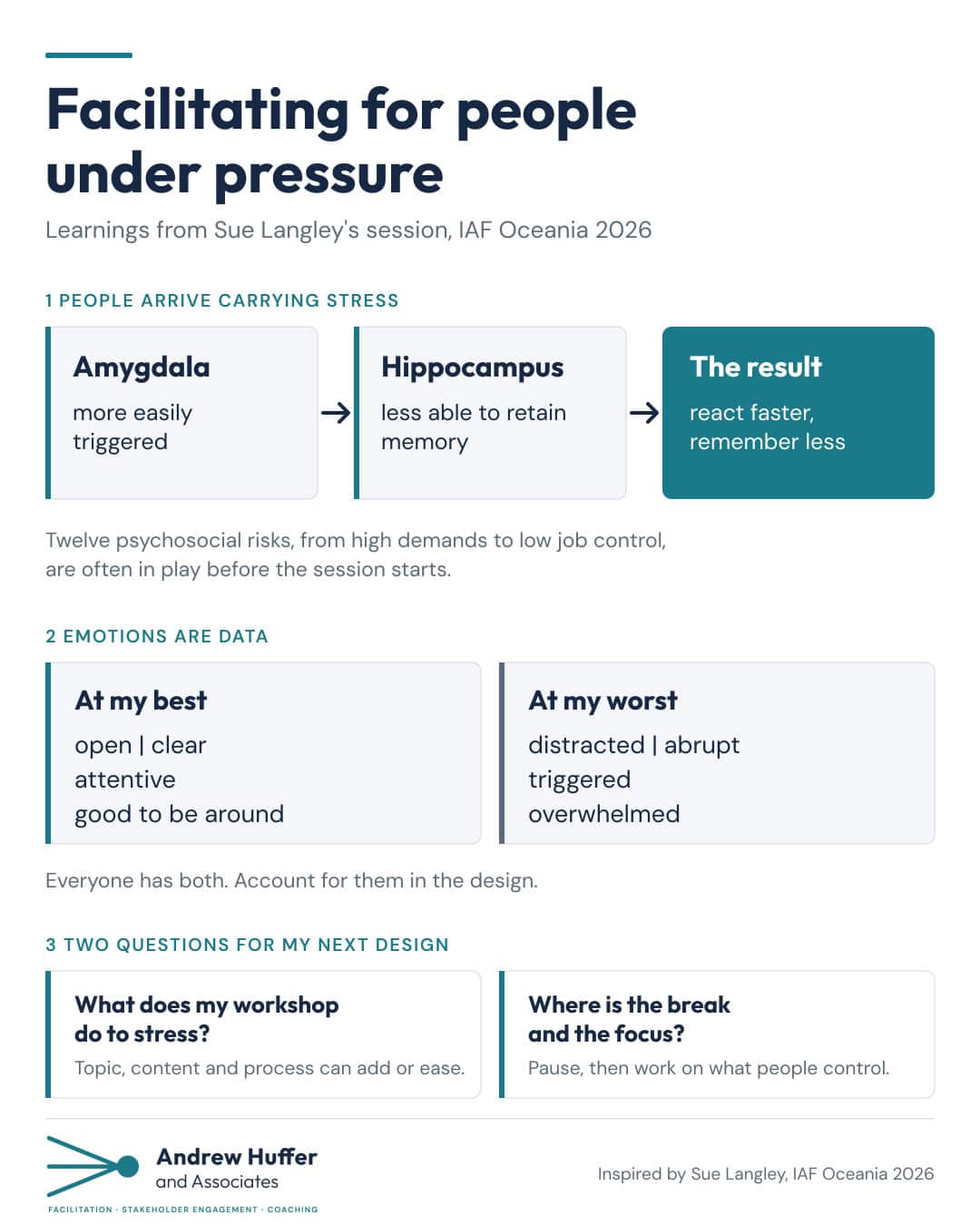
People arrive carrying stress
Sue took us through the twelve psychosocial risks at work, including high demands, low job control, unclear roles, limited support, work-life conflict, organisational change and a sense that the organisation is not being fair. Most participants are dealing with several of these before the facilitator says a word.
She also explained what prolonged stress does to the brain. The amygdala becomes more easily triggered, and the hippocampus loses some of its capacity to retain memory. his was a BIG lightbulb moment for me!
People who have been under pressure for a while react faster and remember less, which can be a poor starting point for a workshop that depends on clear thinking and shared decisions.
Her message was that emotions are data. They are information, and they are trying to tell us something.
An insightful exercise
To make this concrete, we chose two image cards – one for our best mood and one for our worst, and we talked them through in pairs.
At my best, I am:
- Open to new ideas
- Clear
- Attentive; and
- Good to be around.
At my worst, I am:
- Distracted
- Abrupt
- Triggered or overwhelmed.
Everyone has both of these moods, no matter how much we try to have our positive pants on! We need to account for them in our work. It was a very revealing activity to try – simple and effective.
Key learnings
1. Look at what my workshop does to stress
Before designing a session, I want to think about the stresses participants may already be under, and be aware how my topic, content and process will add to them or ease them. A session on a restructure, a regulatory change or a funding decision can heighten stress simply by being on the agenda. I can’t remove the pressure, but I can choose not to add to it.
2. Build in a break and a point of focus
How do I design a process that gives people a break from stress and time to focus on what they can influence and control? I am now thinking about opening activities that separate what is in the group’s hands from what is not, and about steps that move the group’s energy towards the first list.
Questions for my next workshop design
- What pressures are these participants likely to be carrying into the room?
- Will the topic, content and process raise or lower that pressure?
- Where can people pause, and where can they focus on what they can influence?
Know it or not – you’ve probably got people under some kind of pressure attending your next workshop.
If you want to make it easier on yourself, get in touch to get a hand with the design and facilitation.
Read more about Sue’s work or get ideas on Facilitating for People Under Pressure
Got suggestions re Facilitating for People Under Pressure? I’d love to see them – please take a few minutes to share them in my Linked In article.

Reader Interactions