
This week alone I’ve sat across from a firefighter who’s work with high school kids to safely manage Lithium Ion batteries is game changing. I’ve worked with another incorporating neurodiversity research into strengthening their team; and a trauma clinician trying to fit a career’s worth of case studies into twelve minutes. Oh – and a first-time presenter who told me, quite seriously, that she’d rather run into a burning building than stand up in front of the AFAC26 conference crowd!
I get it. AFAC26 brings together thousands of emergency management professionals filling a multi-stream program. Last year’s event drew more than 4,400 attendees from 32 countries and over 200 presenters. If you’re presenting for the first time, it’s s not a small room to walk into.
The Mistake Almost Everyone Makes
For the past few months I’ve been coaching around twenty AFAC26 presenters through their content. Different agencies, different careers, wildly different topics. Almost every one of them is wrestling with the same real question: how do you structure a conference presentation so it doesn’t collapse under its own content?
They lead with the What. The background. The methodology. How the project came about, who was involved, what the literature says. By the time they get to why any of it matters, they’ve got two minutes left and a room checking their phones.
It’s an understandable instinct. You know your topic better than anyone in the room, so you want to prove it. But the audience didn’t come for your methodology. They came for what they can do with it on Monday morning.
How I Structure a Conference Presentation: What, So What, Now What
I use a simple three-part chunk from my Presentations with Impact guide: What, So What, Now What. The proportions matter more than the labels.
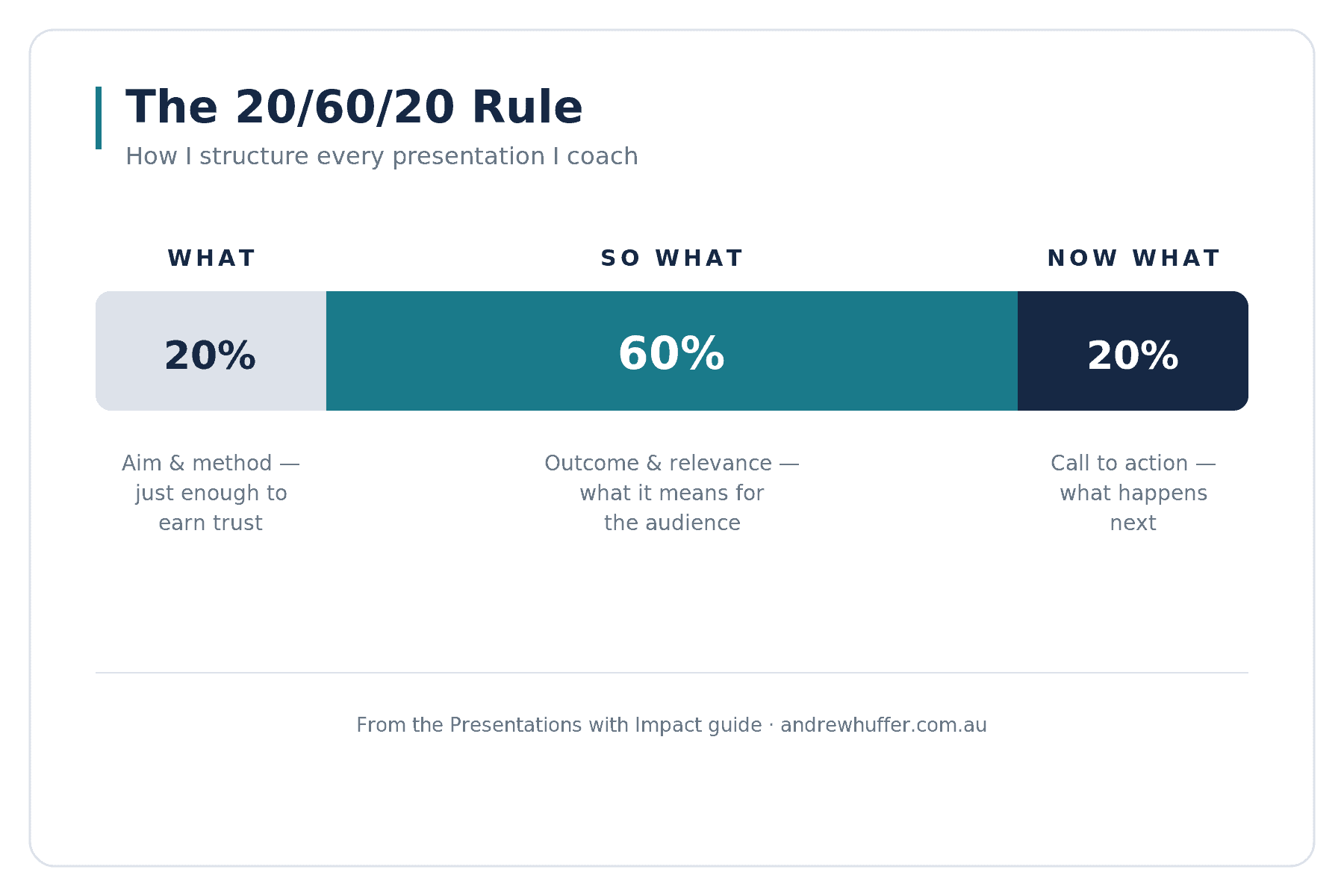
What gets 20 percent. This is the aim of your project and how you went about it – just enough for the room to trust you know your stuff.
So What gets 60 percent. This is the outcome, the benefit, what it actually means for the person sitting in the audience. It’s the part most first-time presenters skip past on the way to the finish line, and it’s the part the room actually leans forward for.
Now What gets the final 20 percent. What should happen next. What you want people to do, try, or think about differently once they leave the room.
It Works Regardless of the Topic
What convinces me this structure holds up is the sheer range of what I’m coaching people through right now. Catharine Phillips from DFES is presenting on volunteer wellbeing and technology. David Clancy from FRV is speaking on neurodiverse strengths in high-pressure response. Michelle Parker-Tomlin is covering trauma treatment for sustaining operational capacity. Peter Martin and Natashjja Heming from FRNSW are presenting on co-designing lithium-ion battery safety with young people. Zoe Schultz from Monash University is presenting on a First Nations women’s empowerment program.
Five completely different fields. Same three-part shape underneath every one of them.
Where the Coaching Actually Happens
When someone sends me a draft that’s eighteen slides of What and three slides of So What, I don’t tell them to cut content. I ask them one question: what do you want the person in seat 47 to do differently on Monday because they heard you speak?
That question usually reorganises the whole presentation. The methodology slide count drops. The “here’s what this means for you” section grows. And suddenly there’s room for an actual call to action, instead of a rushed “thanks for your time” as the clock runs out.
If you’re presenting at any conference where you’ve got more content than time – try mapping your own draft against 20/60/20 before you touch the slides again. It’s the fastest edit you’ll make.
If you want a second pair of eyes on your presentation before August, drop me a line.
Common Questions
What is the What, So What, Now What structure?
It’s a simple way to divide any presentation into three chunks: what you did (What), what it means for the audience (So What), and what should happen next (Now What). The roughly 20/60/20 proportions force you to spend most of your time on the part the audience actually cares about. It’s based on the work of Canadian facilitator, Dorothy Strachan
How much time should each part actually take?
As a rough guide, spend about a fifth of your time on background, three-fifths on outcomes and relevance, and the final fifth on next steps. For a twenty-minute slot, that’s around four minutes of What, twelve minutes of So What, and four minutes of Now What.
Does this work for technical or research-heavy presentations?
Yes – arguably it matters more there. Technical presenters are the most likely to over-invest in methodology because that’s where their expertise lives. The structure forces the translation step: so what does this actually mean for the person listening.

Reader Interactions