Ditch the Ground Rules: How to Build Psychological Safety in a Workshop
For years, I opened every workshop the way every facilitator gets taught to. A slide of ground rules. Respect each other. One conversation at a time. Phones away. I’d watch arms cross before I’d even finished reading them out.
I don’t do that anymore. Not because ground rules are a bad idea in theory, but because I’ve realised they’re not what actually builds psychological safety in a workshop. Something else does that job better, and I only got the language for why this week, at a webinar by Cynthia Mahoney.
The real bottleneck isn’t information
Cynthia’s the author of Cultivate, and she spends her time thinking about where neuroscience and stakeholder engagement meet. Her opening point landed hard: the limiting factor in engagement isn’t information anymore. It’s cognitive and emotional capacity.
When people are stressed, overwhelmed, or uncertain, the amygdala takes over. The prefrontal cortex — the part doing your actual new thinking — goes quiet. As Cynthia put it, ‘you can’t teach someone to swim while they’re drowning’.
Translate that into a Tuesday-morning workshop room: if your stakeholders walk in already stressed, defensive, or braced for a fight, no amount of clever design gets you the engagement you’re after. You could have the best-sequenced agenda in Perth and it won’t matter. The room isn’t ready to think yet.
Check your own state first
Cynthia frames this as ‘Me, We, Us’. Check your own state first (Me). Build the relational environment (We). Then, and only then, tackle the system (Us). It’s roughly the order I’d landed on through 25-odd years of running workshops — I just didn’t have her language for it until this week.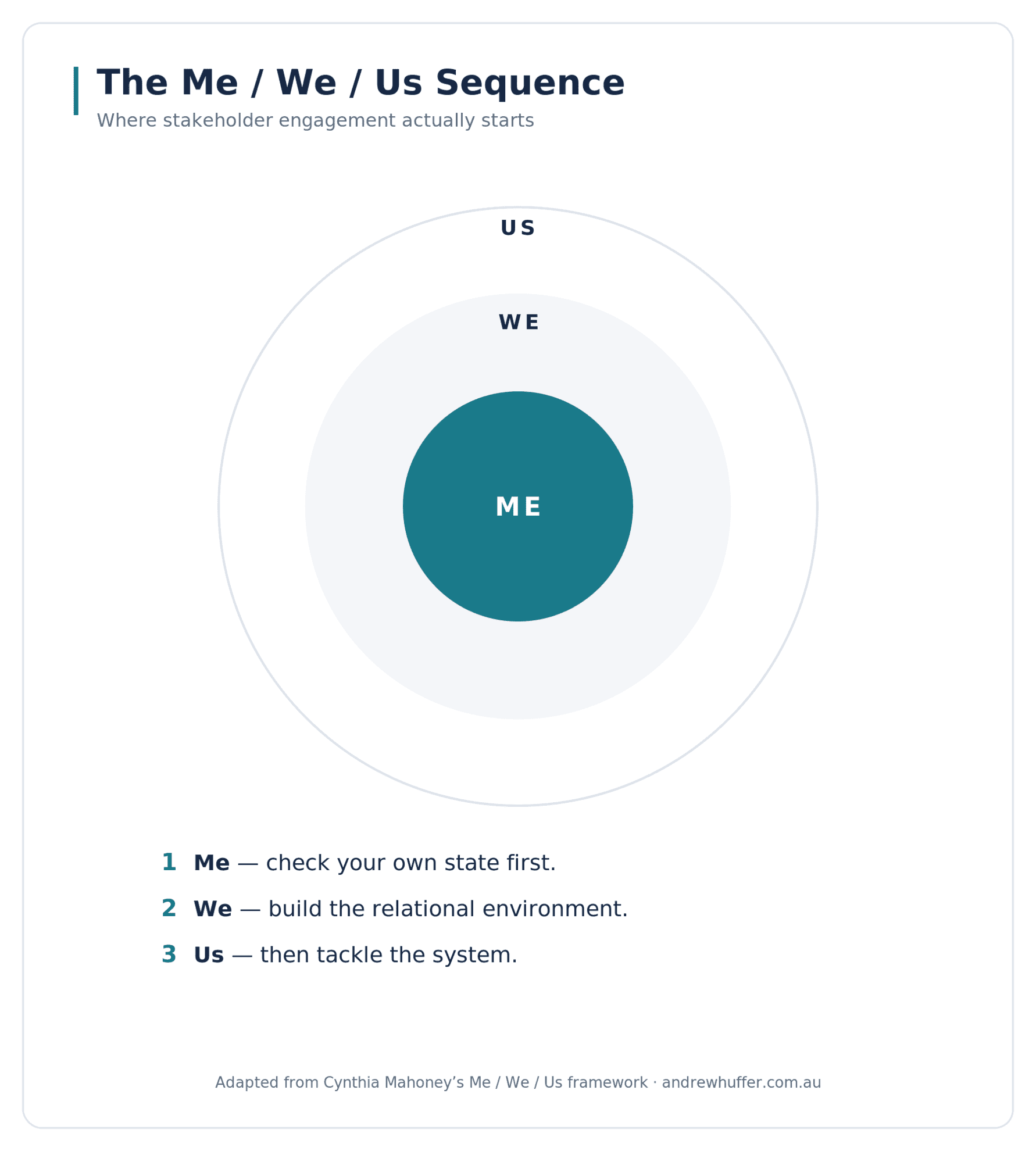
Your stress is contagious. If you’re rushed, anxious, or already mentally at your next meeting, the room feels it before you’ve said a word. Checking your own state isn’t a soft add-on. It’s the first move.
Why ground rules don’t build psychological safety
Ground rules are aimed at the We — meant to set expectations for how the room behaves. But because they’re framed as rules, they put people into a compliance mindset before they’ve had a chance to get curious. You’re telling a room full of adults what they’re not allowed to do, before you’ve given them a reason to want to be there. That’s not psychological safety. That’s a classroom.
What I do instead: Above the Line
I use the Above the Line model instead of a ground rules slide. It’s a simple framework built around choice — how people respond to events, rather than the events themselves. When someone’s operating Above the Line, they’re taking responsibility for their part in the room. They’re looking for what’s possible, and what their own role could be in making progress. Below the line, people default to blame, excuses, and waiting for someone else to fix it.
So instead of ground rules, I ask participants to look for the opportunities in the topic at hand, and to think about their own role in making progress on it. Same outcome as ground rules (everyone knows what’s expected) but the tone is completely different. One says don’t. The other says what if.
It’s also the fastest way I know to check my own state before I ask anything of a room. If I can’t genuinely find the opportunity in what we’re about to work on, the group will feel that in about four minutes flat. Your stress is contagious. So is your curiosity.
The lesson from Cynthia’s webinar wasn’t really about neuroscience. It was permission to stop treating engagement as a design problem when it’s actually a state problem — yours first, then theirs.
If your stakeholders keep nodding along in the room and doing nothing afterwards, it might not be your agenda. Drop me a line at andrew@andrewhuffer.com.au and we’ll talk about what’s actually going on before your next session.
Common questions
What’s the difference between ground rules and the Above the Line model?
Ground rules set boundaries — what not to do. Above the Line sets orientation — what’s possible, and whose job it is to make it happen.
How do you manage your own state before a high-stakes session?
I run the same Above the Line thinking on myself before I ask it of anyone else. If I can’t find something worth being curious about in the topic, the room will pick up on that before I’ve said a word. Having participants know where we’re headed coming into the workshop also helps!
Does this work with senior or formal stakeholder groups?
Yes – arguably more so. Senior stakeholders are often the most defensive walking in, because they’ve got the most invested in already having the answers. Above the Line gives them a way in that doesn’t require admitting they don’t.
Want more help? Contact me or Book a call

Reader Interactions