“Count the number passes of the basketball made by the team in white.”
That was the instruction. I’d seen the video before, so I knew about the gorilla. I counted anyway, spotted the gorilla right on cue and felt rather pleased with myself.
Then Michele Tocci asked the room what else we’d noticed. Had anyone seen the colour of the curtains change on screen? A player walk out of the scene?
Not me. Twenty-five years of facilitating, a head start on the trick, thought I knew a bit about engage participants in workshops – and I still missed two things in plain sight. Argghhh!
That was the opening of Michele’s session at the IAF Oceania Conference in Geelong, “The Science of Engagement: How to Design Sessions the Brain Can’t Ignore”. It left me with an uncomfortable question. If I can miss that with my eyes wide open, what are my workshop participants missing while I’m talking?
Why participants miss more than we think
Michele’s starting point is that engagement needs three things: connection, interaction and attention. The brain is a filter. It’s constantly deciding what matters, and it drifts. Her numbers on forgetting were sobering: about half of what we hear is gone within an hour, and around 70 per cent within three days.
Most of us know this on some level. But knowing it and designing around it are different things. Here are three changes for me to make.
1. Check in more often, because silence isn’t agreement
A quiet room can feel like a room that’s with you. Often, it’s a room that has drifted.
Michele asked us how often our learners’ brains are firing up. I couldn’t give her an honest answer, which says plenty.
She offered simple ways to find out:
- A 30-second quiz where people ‘throw it out’ – ask “What stood out most?; or What’s the first thing that comes to mind?”
- Run mini reflections at the end of each chunk of your session
- Leave more time for reflection at the end of the session.
And a rule of thumb for pacing: 20-minute chunks, with 8-minute engagements.
I’m shortening my chunks and building in more check-ins. If the first thing that comes to mind isn’t what I intended, I’d rather find out at minute 20 than on the drive home.
2. Ask better questions (starting with “Any questions?”)
“Any questions?” asks people to put their hand up and admit they’re confused in front of everyone. Most won’t.
Michele’s take was that engagement always begins by asking a question. So why do we default to telling? She named four reasons: fear of judgement, ego and identity, cognitive comfort and cultural norms. Telling is comfortable. Asking means waiting for an answer.
Two swaps I’m borrowing. First, instead of “Any questions?”, I’ll try “I’ve been talking a lot. What would you like me to clarify?” That puts the weight on me, not on them.
And I’ve now decided to give this some specificity and use “I’ve been talking a lot. What two things would you like me to clarify most?”
Second, open with a question people can answer from their own experience. Her example was a trainer working with apprentice mechanics asking, “What cars have you worked on?” For my groups, it might be, “What groups have you been working with?” Everyone can answer, and nobody can get it wrong.
3. Watch the four levels of safety
When someone goes quiet, I’ve often assumed they had nothing to add. Michele’s line stuck with me – “People didn’t stop thinking, they stopped contributing.”
She describes safety in four stages. Each one is a question a participant is silently asking.
- Inclusion safety: Do I belong?
- Learner safety: Is it safe to learn?
- Contributor safety: Does my contribution matter?
- Challenger safety: Can I challenge an idea?
The barriers are familiar once you name them: fear of other people’s opinions, concerns about literacy, a worry that what I say may be used against me.
Two ways to build safety came through strongly. Share something about yourself and invite others to do the same, escalating gently over time (Michele calls it escalating mutual vulnerability). And find common ground: we grow together where we go together.
Before my next session, I’ll ask which of the four is most at risk for that particular group. A team meeting for the first time and a team with ten years of history need different things.
What I’m changing
- Shorter chunks, with mini reflections between them.
- More time for reflection at the end of a session.
- Swapping “Any questions?” for a question that carries the load.
- Asking myself which level of safety may be most at risk before each session.
- Closing with Michele’s challenge to participants: what are the two things you’re going to own, take away and use?
Michele handed us a better set of questions to ask ourselves. How often am I checking in? Are my questions doing any work? Who has gone quiet, and why?
If you run workshops and want to talk about how to engage participants in workshops then contact me and we’ll book a call.
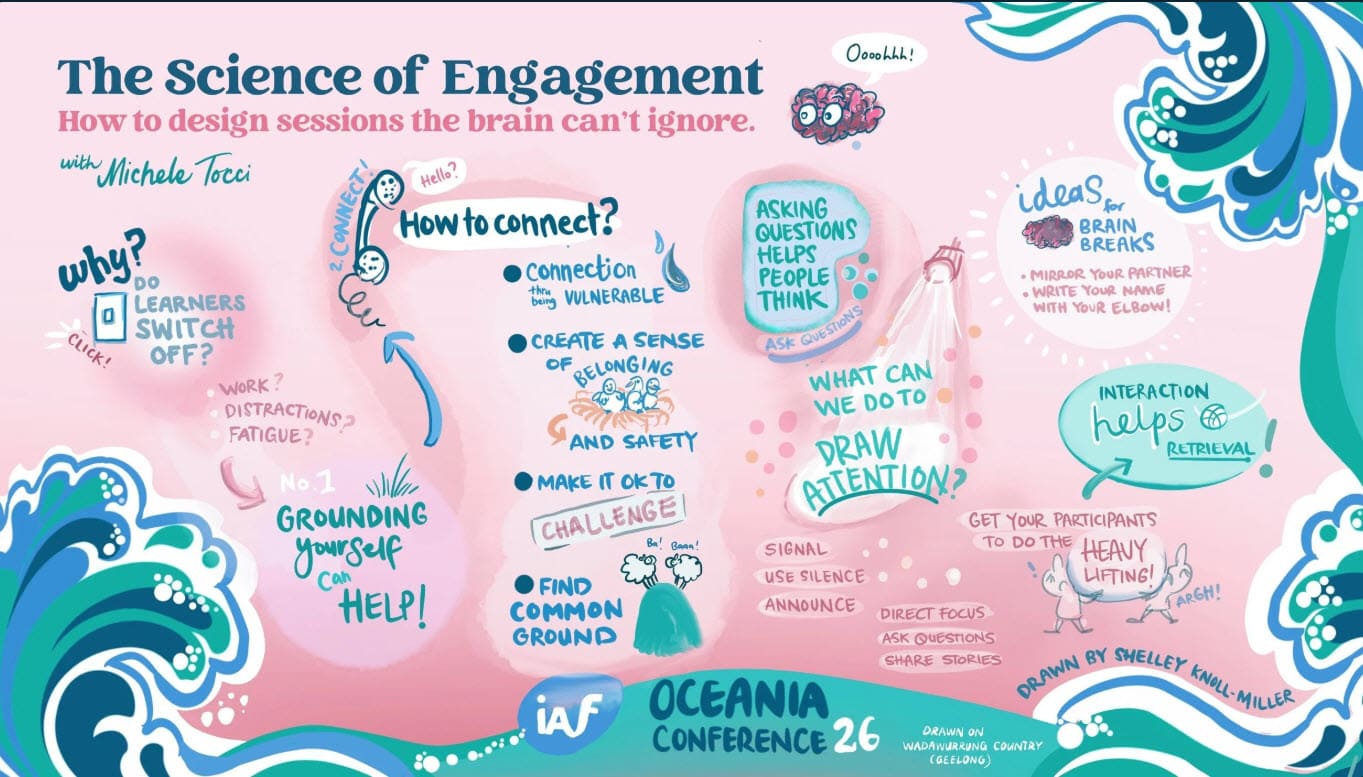
Thanks to Michele Tocci for a session that rattled my assumptions, and to Shelley Knoll-Miller for the graphic recording of it.

Reader Interactions